Thursday, May 1, 2014
Thursday, April 24, 2014
Sugar Ridge Road Bluebonnets
After work on Good Friday I headed out to Bristol, Texas for a little plein air action in one of the best bluebonnet locations in Texas. The area has lots of rolling hills and Sugar Ridge is one of the highest points in Ellis County so there are some great vistas to work with. The smell alone was worth coming out for.
By the way, Bristol is home to some of the best sushi in the Dallas/Fort Worth area. Hard to fathom considering the population is probably 50 on a good day, and is completely off the beaten path. You don't stumble upon Bristol. You have to want to go there since it's not on the way to anywhere. Don't let the humble building/gas station fool you. Personally, if someone hadn't told me about this place there is no way I would have stopped here. But the food is worth the drive even when the bluebonnets are long gone.
![]() |
| 9x12 oil on canvas panel |
Thursday, April 3, 2014
Crane Flies In My Paint
I usually get annoyed by the annual crane fly invasion here in Texas in April. Especially since they always seem to find a way to get inside my art studio and, inevitably, in my paint. But for this occasion, I found them to be welcome.
I was about 2 hours into a still life when two of them landed on my main subject, an enameled tin. Since they were sitting so very still for me I thought, "why not," so I decided to try and include them in the painting. Easier said than done since I hadn't planned for them in the beginning stages. But, I figured it was worth the risk, and a great example of being flexible when it comes to painting.
Unfortunately I wasn't totally happy with the one sitting on top so I wiped him off, but the one clinging to the tin on the left is still there. Most people looking at this probably wouldn't notice him, but I think it adds a little interest and a conversation point.
Monday, December 9, 2013
Plein Crazy - outdoor painting in sub-freezing weather
| An icy Mustang Creek |
Saturday was your typical winter day, with nothing but drab gray skies and very little color in the landscape since everything was covered in ice. My location of choice was the same creek at the end of our street that I have painted many times before. But this time I wanted to set up near some falls that I had recently stumbled upon. Funny that I had no idea that this beautiful setting was just a few yards up the creek from where I usually hang out, obscured by evergreen trees around the bend.
Appropriately dressed in insulated hiking boots and a heavy coat, I walked about 100 yards from where I parked through crunchy prairie grass to the falls, carefully stepping on surfaces that had ice-free patches on them and working my way down the bank. I admit that I nearly fell several times, but thank you God, I didn't. At this point I still felt warm from head to toe, encouraged that I could really do this. I had everything set up and ready to go until I realized that I had left my paints at home. Here's where I remind you to always go over a checklist before you leave. I always seem to forget something. Anyway, I took a chance that no human with half his mind would be out here in this weather so I left everything set up, as-is, and drove back home to get my oils... hoping that my gear would still be there when I returned... and thinking to myself how odd this abandoned easel might look to someone if they did just happen to come along. Ten minutes later I was back and ready to go, none worse for the wear.
The one good thing about plein air painting with overcast winter skies is that you don't have to worry about light and shadow changes, for the most part. This can be a bad thing if you don't force yourself to work as quickly as you would normally work. But trust me, the cold weather is more than enough incentive to work fast. About halfway through the session you realize that you are really, really cold and begin to go into a hurry-up offense mode, slapping paint on the canvas like an ape at the zoo.
The worst part about these conditions, other than nearly slipping on the ice-covered limestone, is keeping your hands warm without hindering your style. At first I went with the tried-and-true blue disposable gloves - hoping that I could complete something before it became too unbearable. I realized that they wouldn't be ideal, but figured I could fight through it. I eventually ended up putting on my thick thermal gloves which now match every other bit of paint-dabbed clothing I own. Not easy to manipulate, especially if using a palette knife, but I managed.
![]() |
| #134 Icy Creek - 14x11 oil on canvas panel |
All-in-all, this was a great experience and I recommend that every outdoor artist should try it at least once. This is the type of outing that makes plein air so much more interesting than studio work. Each painting has a story behind it that can only be conceived organically - in the elements themselves.
Wednesday, September 18, 2013
Monday, July 15, 2013
Progressive Plein Air from the Dallas Heritage Village
This past Saturday I made my third trip in the last four weekends to the Dallas Heritage Village in Old City Park. This was in preparation for the upcoming plein air show, Following Frank Reaugh: a celebration of plein air painting.
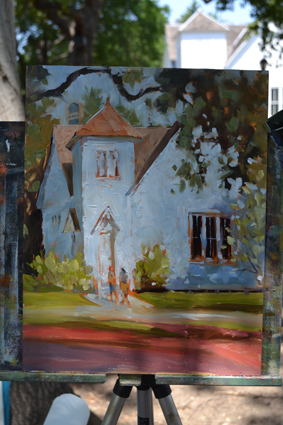
My subject this time around was the old Pilot Grove Methodist Church. It was built around 1895 in the small community of Pilot Grove, Texas, southeast of Sherman. I decided to take progressive photos along the way if you care to follow along.
In the upper left corner you will notice a subtle hint of downtown Dallas peeking above the roof line. It was important, in my mind, to find a scene that included some "old and new" elements. I'm always looking for contrasting subject matter. It's so subtle that it probably won't be noticed right away, but that's what I like about it. Paintings should never tell the whole story in one quick glance.
My subject this time around was the old Pilot Grove Methodist Church. It was built around 1895 in the small community of Pilot Grove, Texas, southeast of Sherman. I decided to take progressive photos along the way if you care to follow along.
![]() |
| #97 Pilot Grove Methodist Church - 14x11 oil on panel |
In the upper left corner you will notice a subtle hint of downtown Dallas peeking above the roof line. It was important, in my mind, to find a scene that included some "old and new" elements. I'm always looking for contrasting subject matter. It's so subtle that it probably won't be noticed right away, but that's what I like about it. Paintings should never tell the whole story in one quick glance.
My location. This building would make a really cool house. It was hot outside, but I hardly noticed because I had lots of shade and a nearby fountain providing sounds of cascading water.
I started my outline with a round sable brush and a little cad orange and burnt sienna. I find that this color combo can come in handy later in the painting if I need a few glowing accents here and there.
I begin placing a few of my darkest values. This is like working on a clay sculpture as I define and carve away the negative shapes.
More dark values, and just a hint of the building peeking over the roof line in the distant skyline. I also throw in the outlines of two people standing in front of the entry. I usually try to add some size perspective and people work well for this. And, they are easier to paint than the banister behind them.
Here I freeze the moving shadows like a camera freezes the moment. From here on I have to try to ignore the changing light and go with this time of day. This blue looks strange here, but once I add the sunlit areas of the wood it will hopefully begin to look natural.
I begin blocking in some local color and some of my lightest values. Notice how the same blue as above now looks less blue and more natural. Some of that might be my camera's doing, but you can see how the added color has changed the way your mind perceives it.
After four hours I'm near the finish line. My goal is always to work faster than that, but the majority of the painting was done in three hours. A few touches here and there and I'll sign it. This is where I can get into trouble if I start reworking areas that don't need it. I've ruined many paintings that way. You can see here and there, that I've left some of the original orange outlines for some subtle highlights in the trees and nooks of the building.
Tuesday, June 11, 2013
So You Think You Can't Paint? (you probably can't but...)
![]() |
| #93 - Katy Depot Caboose plein air - 9x12 oil on gessobord |
Now, don't get me wrong. I do admire anyone that will stick to something like singing or painting, no matter what anyone thinks about the results... at least to a point. It might be painful to see or hear, but it's admirable. And many of those artists that I just don't get have made a living selling their works as soon as they leave the easel, so what do I know? But I'm thinking that if there was an American Idol for artists, these would be the ones that are completely shocked and in tears when they are told to exit stage left because their painting sucks.
A little over a year ago I decided to take the plunge and buy a set of oils and brushes. After 30 years of mostly watercolor, I wanted to try something I've always been curious about. Would this be a step in a new direction, or a complete failure? I really had no idea how this would go. So one of my first attempts with oils was a plein air of the Katy Depot caboose in Waxahachie. In the Spring of 2012, several local plein air artists were invited to paint during a miniature-train exhibit that was held inside the depot. In spite of the fact that I had no clue about technique or how to begin, I jumped in with both feet. I was hoping that since I had a lot of experience with watercolor that I could adjust and learn on-the-fly. How much different could it be?
Probably the biggest thing I learned from that day was that most oil painters put down their darks first as a rule. Good to know. But unfortunately something I picked up after the fact. There was also this little detail about thin shadows and thick highlights... just a couple of things that watercolorists don't normally deal with. Needless to say it wasn't an encouraging experience. The possibility that I had wasted $100 on new supplies was crossing my mind with each brush stroke. Even though I knew that you have to go through a lot of canvas to even approach a decent painting (for most artists anyway), I was embarrassed for anyone walking by to see the atrocities that were happening on my canvas. "I'm new at this whole oil thing" and "I usually paint with watercolor" were my constant apologetic disclaimers for the day. Oh well, I would rather have my first attempts be my worst attempts than the other way around.
Fast forwarding some 15 months (and 47 paintings later) I thought it would make for a good blog to show how I have progressed during this time, if at all. #93 - Katy Depot Caboose is a plein air of the same subject, but from a different angle with the Katy Depot in the background (top of post). I painted from across the street with my easel set up on the historic Rogers Street Bridge.
To be fair (to myself) the weather on the first attempt (right) was dreary and overcast, with occasional rain and mist - as opposed to the bright late-afternoon sun I had last weekend. But looking at these two side-by-side I feel a sense of encouragement in that I can see definite improvement. And hopefully, I will be able to paint this same caboose in the future for further comparisons. With that said, there is the distinct possibility that I'm one of those paint-blind artists and an intervention might be in order. If so, please be gentle.
Now back to my initial rhetorical question of whether you think you can't paint or not... maybe you can't, but maybe you can. Just don't give up after one try. I will add that if you don't see any improvement over the next 47 paintings, as my Dad would have said, "try about 10 more and then give it up completely."
Subscribe to:
Posts (Atom)